Friday 26 July
22°C and Scattered Clouds
Another milestone: Agnes is closed to the public as we prepare for Agnes Reimagined. Stay tuned for plans for off-site programming!



Sustain Agnes programs and collections by making a gift today.
Donate
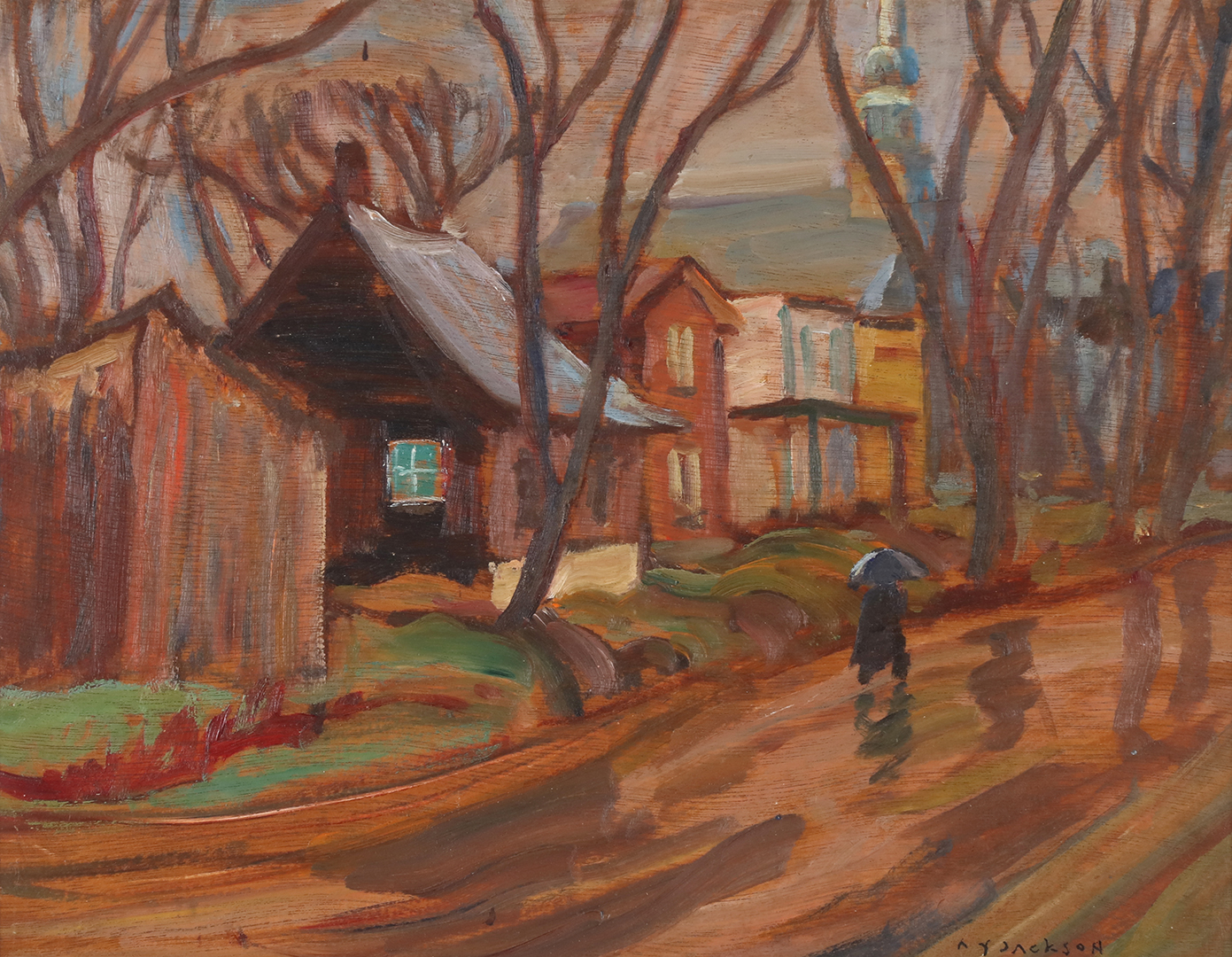
A. Y. Jackson’s identity is forever entwined in Canadian art history with the Group of Seven. More than any other member, he took to heart the Group’s myth-making land-based nationalism. His long-held belief in a distinctively Canadian art culminated in his autobiographical tome A Painter’s Country (1958), and his extensive body of landscapes served as tribute to his nationalistic outlook. Jackson trained at the Conseil des arts et manufactures and Art Association of Montreal (1896-1899), the Chicago Art Institute (1906-1907) and the Académie Julian in Paris (1907); however, the vigour of painting outdoors captured his interest more than the rigour of studio life drawing. Upon his return to Canada, he found a sympathetic outlook among artists in Toronto, where he eventually moved in 1913. Jackson, however, maintained ties with the art scene of his home city, and in 1920 became a member of both Montreal’s Beaver Hall Group and Toronto’s Group of Seven. After the latter expanded into the Canadian Group of Painters, encompassing wider cross-country membership, he remained a faithful CGP member until it folded in 1969.
Jackson was a consummate traveller, applying a style he had honed early in his career to changing Canadian views, whether Algonquin Park, Albertan foothills, or Arctic ice flows. The Quebec landscape, however, always had a pull for him, particularly communities along the St. Lawrence. In his typical sweep of a street, tangle of trees, and multi-coloured houses, Jackson captures a quiet urban moment with–unusual for him–a lone figure holding an umbrella.