
Friday 26 July
22°C and Scattered Clouds
Another milestone: Agnes is closed to the public as we prepare for Agnes Reimagined. Stay tuned for plans for off-site programming!

Sustain Agnes programs and collections by making a gift today.
Donate
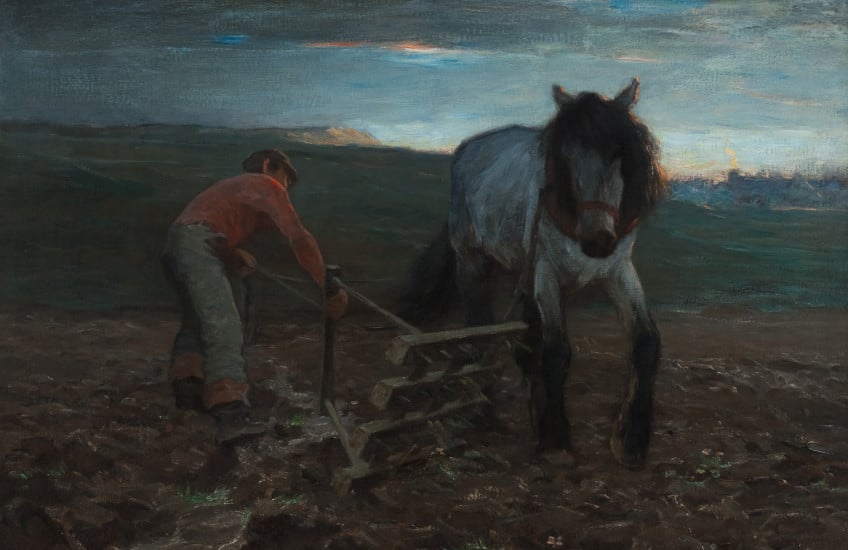
>> Inspired by global art movements such as the American and French Barbizon schools, Horatio Walker’s Turning the Harrow – Early Morning demonstrates the artist’s interest in painting simple, nostalgic views of real-life often set in the bucolic landscape of the Île d’Orléans in Quebec. Anne-Marie Bouchard, curator of modern art at the Musée national des beaux-arts du Québec explains.
>> Just as the American Barbizon painters, Walter was really influenced by the French Barbizon school. And he kind of valued simple and pastoral scenes painted directly from nature. He liked to paint the kind of traditional activity mostly taking place during the sunrise. And he always painted the same kind of scenes. I mean it was sheeps, cattles, chickens, pigs, always in the sunset or sunlight with the peasant working by their side. And he was really interested in just trying to put a kind of majestic landscape in which the animals could be at their most beautiful. He put a lot of effort in depicting the way of life and he had the kind of idea that the peasant and his relation to the landscape was conveying a kind of spiritual strength that was really particular. It was an idea that was absolutely generalized in French painting at the same time. And that was really popularized also by the political parties that were seeing the peasant and also the labourer as someone who had a kind of authenticity that was different from what we were able to see in the modern cities. And that it was through the peasant way of life and through the peasantry and the rural life that we were able to find back something we had lost in the industrialization. Walker promoted the kind of romantic concept of the landscape and this is maybe why he kind of fell in love with the Île d’Orléans when he first went there during the 1890s. He wasn’t the only one at that time, but I guess since we could find on the Côte-de-Beaupré James Wilson Morrice and Maurice Cullen at the turning of the century. But they were already working in an impressionist way which was not the case with Walter who kind of stayed close to a more romantic depiction of the landscape with those kind of majestic sunrise and sunsets that he painted in a really different way. There was a distance with which Cullen or Morrice painted the Côte-de-Beaupré and there was not so much distance in the way Walter did because he lived with them most of the time since he had his omen on the Île d’Orléans also. And so he was not as ideologically engaged as was Millet or Courbet in France. They kind of had this relation with political views that it was possible to see that in their painting. We don’t see that in Horatio Walker. And so, he’d really stick to a romantic and nostalgic view of the landscape that was really close to the French Barbizon School and also to the American Barbizon School which I think he was in contact with when he went to New York City a couple of times, so, I mean he certainly know them really well.
>> During the 19th Century, there was a growing interest in works of art that depicted scenes of everyday life. Since Horatio Walker’s Turning the Harrow-Early Morning presents a scene of a young man tilling the soil at dawn, we asked local farmer Charles Summers to take us through the process of harrowing. He shares his views and impressions of this painting based upon his own experience of farming the land.
>> Harrowing is a form of tillage, and tillage is when you work the soil. You would call it a form of secondary tillage. Primary tillage would be like ploughing or turning over land, and of breaking sod, whatever you want to call it. Harrowing is generally done to make a finer seedbed, kill weeds, prepare land for sowing. It’s relatively easy work, unskilled work. This type of job that this guy is doing in the painting, a boy would do that type of job. It’s not as precise. It’s not the job of ploughman, which would have been a man’s profession, like for adults and a very — more esteemed in the hierarchy of, you know, rural skills. These harrows and stuff are [laughs] — I’ve never used a wooden one. I have old sets of diamond drag harrows, you would call it. They’re basically the same. The spike tooth harrow. And they’re awkward because they do want to tend to flip when the horse turns sharp as he’s doing here. And from an agricultural or a farmer’s perspective, you have to look at this gentleman and feel sorry for him to a certain extent. Just having done this type of work and I — it is truly toil. And this is a very — obviously a strain. It doesn’t actually look like it’s going well necessarily, although, you always have to — you have to turn at end of the field, of course. This poor guy is also obviously out at the break of dawn here because you had to — when you’re going over a field three feet at a time, you have to put in a very long day. And that’s a long day for him and a long day for that animal, too. I mean, I guess he was looking to show something on the farm which was nostalgic. And there’s a magical quality to horses. So it’s easy to get like overly romantic or sort of to glamorize that beauty and that power. And then instead what he has here is very humble, very small and quiet. You know, this isn’t the Budweiser Clydesdales. This isn’t like 30 horses pulling a combine on a hill in Oregon or anything. It’s a very — this could be anywhere in the world at any time over the last, you know, 4,000 years. This is base level existence actually, this level of technology. And it’s very lonely, obviously. And I think that’s what sort of surprises me about this because I think when you look at nostalgia for the old ways in agriculture, a big part of that is because it was always like a community undertaking. You really couldn’t do everything by yourself. Not that you can today either, but there was a very like real family and community element. And instead here, we have one boy probably and his, you know, his nag of a horse, you know. And so it’s very humble, very plain.
>> How did Turning the Harrow – Early Morning arrive at Agnes and at Queen’s University? This painting has an unusual story in and provenance. Alicia Boutilier, Chief Curator and Curator of Canadian Historical Art at the Agnes Etherington Art Centre discusses the adventurous tale of how the painting was once held at the Metropolitan Museum of Art in New York City and ultimately found its home in the Agnes collection of Canadian Historical Art.
>> Horatio Walker’s Turning the Harrow – Early Morning, has had a winding path of institutional ownership, indicative of changing fashions in art. The Ontario born artist made a very successful living through painting. Horatio Walker was talented, but also trend savvy. When the artist chose rural Quebec as the sustained subject for his art, he was joining a popular movement in American painting. As my curatorial predecessor, Dorothy Farr, has pointed out, it was the Barbizon style that sent Walker to Quebec and not Quebec that inspired a Barbizon style. By the late 1800s, when Walker was painting Turning the Harrow, he divided his time between summers on Île d’Orléans, just east of Quebec City, and winters in New York, where he had an art dealer on Fifth Avenue. He was an elected member of the Society of American Artists, and an associate, later full member of the Royal Canadian Academy of Arts. You could say he held dual artistic citizenship, but his market was really in the U.S. Wealthy Americans who had been collecting European art to represent a cosmopolitan view began to pay serious attention to art produced at home. Significant among those collectors was New York merchant George Arnold Hearn. Hearn was hailed as a contributor to the cause of contemporary American art. And as part of that cause, in the 1910s, he donated two Horatio Walkers, including Turning the Harrow, to the Metropolitan Museum of Art, where he served as a trustee. Turning the Harrow hung for years in the museum. Walker having been fully adopted as an American artist. Then in 1956, the painting was deaccessioned and sold and kind of disappeared from the record. Though the Metropolitan Museum of Art kept its other Walker from Hearn, also of a harrower, American art and Canadian art, for that matter, had moved on to champion other movements by the mid-20th century. Around the same time, the Corcoran Gallery of Art in Washington also deaccessioned their Walker painting, entitled Ave Maria, which is now in the Art Gallery of Hamilton Collection. In 1977, the Agnes Etherington Art Centre mounted a comprehensive exhibition on Walker, with a publication by Dorothy Farr. As part of a professed series of reappraisals of Canadian artists who were important and successful in their own time, but who had fallen out of fashion. There was renewed interest in Walker’s work, as the story of Canadian art was being assembled and historicized in the post-centennial years. At the time of the exhibition, the location of Turning the Harrow was not known. But the ground was set so that when it emerged at auction again in 1994 it was purchased for the collection here. How to look at Horatio Walker today. A privileged artist, claimed, erased, revived, questioned, in two colonial countries, asserting nationhoods. There are so many critical issues raised through such idealization of labour, but I’m still arrested by the painting. It tells me something about enterprises imposed on the world, but also something about colour. The arrest lies not in the high-keyed tones of impressionism or the hot hues of post-impressionism, movements that superseded Walker’s popularity, but in the low light of dawn. The way the horse’s ears and mane are limbed from behind by the same light that catches the farmer’s right shoulder. The silvering of the land before warming up on a chilly morning, Walker really nails it. I retreat temporarily to his use of paint in depicting this scene.